
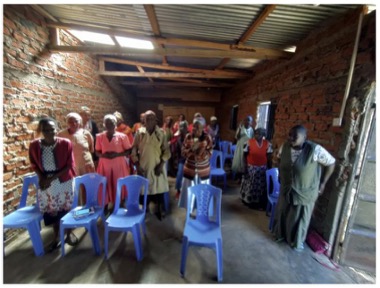
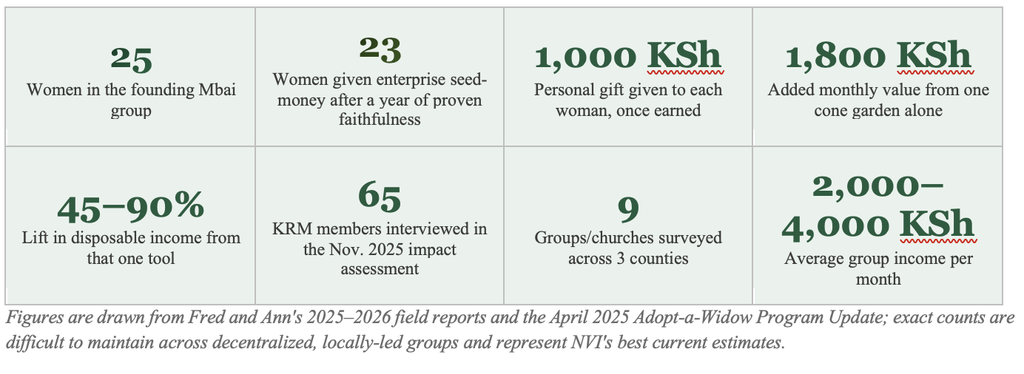
NewVines International’s Adopt-a-Widow Program began in Eldoret, in Uasin Gishu County, and remains, in the words of NVI’s own Ten-Year Anniversary Retrospective, “the home of NVI’s pilot Adopt-a-Widow Program.” It was built around a specific and painful profile: women who have both lost their husbands and experienced abuse — most often sexual abuse — at the hands of in-laws, their community, or both. The group at the center of this report is Mbai’s own: roughly twenty-five widows who meet at the Mbai training centre in the KRM church network near Eldoret.
Guiding Principles, Lived Out
NVI’s Ten-Year Anniversary Retrospective names three deliberate shifts in how the organization has come to understand what it means to bless the poor. Ten years into the work, the Mbai widows are among the clearest living proof of all three.
From Projects to People
“The people must always come first — before the institution, before the program, before the metrics,” the Retrospective states. “The NVI training goes right to the individual’s lives,” a parish partner in Tanzania observed of the same approach. “The other groups that come to work with the Parish are trying to build capacity in the Parish with big projects, but the NVI training goes right to the individuals first. We can feel the difference.”
At Mbai, that principle is not an abstraction. Each widow is visited, named, and known — by Ann, by Fred, and eventually, in person, by NVI’s president. Each was given her own cone garden and her own place in the group’s Table Banking circle. It would be a full year and more before that personal attention turned into a personal grant — and only once each woman had proven, on her own, that she could be trusted with what she already had (see “The Work on the Ground” below).
“Before the NVI training I used to beg a lot, and was taken advantage of by men. But afterward I learned that with a kitchen garden in place, I would never need to buy vegetables again — I eat some and sell some. I use the envelope system: one for savings, one for tithe, one for household money. From the garden’s proceeds I bought three chickens, which now lay eggs I sell too. I started a small business in ripe bananas, avocados and groundnuts, and I plough my profits back into it. I can provide for my family’s basic needs — even books and pens for my children.”
— Martha, Mbai Widows group
From Handouts to Stewardship
The Retrospective describes a mindset shift NVI now actively teaches across all of its work: moving people “from a poverty mindset — ‘What can I get?’ — to a stewardship mindset — ‘How can I faithfully use what God has given?’” Before the program reached them, the widows of Mbai lived the first half of that sentence. NVI’s own April 2025 program update, drawn from interviews conducted on a visit to the group, recorded their own words for what “low” once meant: “We were all very low.” “I used to beg for vegetables.” “I used to sit and wait for someone to provide for me.” “I was in darkness.” “I thought I was too old to work.” “I was lazy, because I did not know what to do.”
What changed it, in NVI’s own account, was three things given together: training, a Cone Garden, and a Christ-centered mutual-support group built around saving and “Table Banking” — small loans for small businesses. The result, widow by widow, has been a steady, self-reported shift toward stewardship.
“Before the NVI training I was just walking aimlessly, gossiping and talking. But afterward I gained wisdom and learned to save in the areas where I had been spending unnecessarily. I bought five chickens and added them to the ones Ann had given me — they are all laying now, and I sell eggs at 20 shillings each. I buy food, books and pens for my children. There is a great difference in my life now; I use my time well by staying busy.”
— Elizabeth, Mbai Widows group
“Before the NVI training I didn’t know how to budget, but afterward I learned to plan my income. I have a kitchen garden and sell kale for about 560 shillings a week. I pray and pay my tithe, then buy sugar and tea leaves, and I save 30 shillings every day — about 210 a week, with 50 going into our group savings account. I keep records every day, and I use my savings to buy medicine when I need it. From my own savings I bought three chickens, and with the ones Ann gave me I now have seven — all laying.”
— Imelda, Mbai Widows group
Restoring Dignity
The women of Mbai put this shift in their own words, offered by one of them on behalf of the whole group: “You have changed us from Proverbs 14 women (foolish) to Proverbs 31 women (wise and industrious.)” NVI’s president, recording the moment, added two words of his own: “hope-filled” and “confident.”
“After the NVI training I started doing things differently. I planted a kitchen garden and stopped buying vegetables — once they were ready, I began selling instead, and saving in a small way. From my garden I now earn about 420 shillings a week. With those savings I started businesses in sugarcane, tomatoes and bananas — buying cane at 200 shillings and selling it at 350, bananas at 300 and selling at 550. I keep records, I give tithe from my profits, and I budget and stick to it.”
— Rose, Mbai Widows group
The Work on the Ground: The Mbai Widows’ Journey
Read in order, Fred and Ann’s monthly reports on the Mbai widows trace a clear progression — not a single handout, but a sequence of steps in which each stage of trust was earned before the next was offered.
Stage 1 — Onboarding & Training (January–March 2025)
- April 2024 – Commenced initial formation of the Mbai group. Cone Gardens provided for all women. Training emphasizes sound stewardship, biblical principles.
- January 8–9, 2025: the Jecades Mbai women’s group is formed and onboarded onto the Dream Save (DSL) app; Ann Godiah herself, as the group’s secretary, becomes its primary bookkeeper alongside her role as trainer.
- February 5–6, 2025: a kitchen-garden documentation visit finds the widows already eating from their gardens — some selling surplus vegetables and using the proceeds to buy their first chickens.
- March 26–27, 2025: a second Mbai group, the “Mbai Precious Women,” completes its own onboarding under chair lady Rose, saving 250 shillings each in its first cycle.
Stage 2 — First Fruits (Spring–Summer 2025)
- Twenty-five cone/kitchen gardens are fully distributed across the two Mbai groups, and vegetables move into steady production.
- Widows begin eliminating their own vegetable purchases entirely, selling what they don’t eat, and tithing starts to rise.
- The Jecades group begins lending among its own members — an internal, Table-Banking style of mutual credit, run and recorded by the widows themselves.
Stage 3 — Proven Faithfulness (September–November 2025)
- A formal KRM-wide Impact Assessment, carried out that autumn, includes the Mbai savings group among nine groups and churches surveyed across Bungoma, Trans-Nzoia and Uasin Gishu counties, interviewing 65 members in all.
- The results show the large majority of members — 55 to 90 percent, depending on the measure — meeting concrete benchmarks for written savings goals, budgeting and record-keeping. It is this evidence, gathered on the ground and not assumed from a distance, that told NVI the group was ready for what came next. A cone garden in full production.
Stage 4 — Reward and Investment
- April 27–28, 2026: a regional Eldoret meeting is followed the next day by a dedicated Mbai widows meeting, where the group’s own account of its transformation is gathered as testimony: “After the NVI training, all of us planted kitchen gardens… Before the training we used to beg; now we try to provide for ourselves.”
- May 2026: NVI’s president visits the group in person. Only now — more than a year after training began, and only after the Impact Assessment had confirmed the group’s own faithfulness with money management and their cone gardens — does he leave a personal gift of 1,000 shillings for each woman, explicitly as recognition rather than a starting handout. Seventeen of the twenty-five put it straight into poultry rearing; others invest it in vegetable seed, sugarcane, banana and avocado businesses of their own choosing.
Stage 5 — Sustained Stewardship (June–July 2026)
- “Mbai widows meetings” become a fixed, recurring line on Ann’s monthly calendar rather than a special event.
- The seventeen new entrepreneurs are tracked by name, month over month: Rosemary A. moves from sowing vegetable seedbeds in May, to transplanting in June, to harvest by July; Roseline N’s sugarcane-and-banana business and Martha M’s chicken-and-avocado business are both reported “doing well.”
- A batch of fermented chicken feed, prepared at the NVI retreat, is delivered to the group to feed its now-growing flocks — one more small, practical tool handed over once the group had shown it could be put to good use.
Part of Larger Body
The Mbai widows are not served apart from the church; they are trained, met, and supported inside it. On the very trip that first brought NVI’s leadership to Mbai in February 2025, the visit was preceded by a meeting with KRM’s own pastors in Eldoret, where Bishop Collins Mukanda described what that church-based structure has meant for members like them: “The NVI training has relieved the church burdens towards our members… the church members are no longer complaining about help of house rent and sleeping hungry… Vulnerables have gained and are looking at themselves as people who can do something in a small way.” That is the benefit flowing toward the widows — pastoral oversight, a place to meet, training brought to their own church, and a body of believers no longer treating them only as a burden to be carried.
The benefit runs the other way as well. At that same pastors’ meeting, Bishop Collins noted plainly that “our NVI president will be using our testimonies to do fundraising” — and it was on that same trip that NVI’s president visited Mbai directly and recorded the testimonies quoted throughout this report. The widows’ own stories of transformation have become part of what sustains NVI’s broader work, including, as the final section below describes, the newest groups now opening in Nairobi. Elsewhere in the KRM network, that same spirit of mutual care shows up in concrete form — the Gagra group, for instance, has built a standing welfare fund that raises 500 shillings for any member who loses a loved one — the kind of church-rooted mutual support that Mbai’s own Table Banking circle echoes in its own way.
More Testimonies of Transformation
Beyond the individual accounts already woven into this report, the following voices round out a fuller picture of what the past two years have meant for the women of Mbai.
“After the NVI training I planted a kitchen garden and began selling vegetables from it. I sold some and bought four chickens, adding them to the one Ann had given me — eight in all. I sold six of them for 5,600 shillings and used the money to lease land, which I had never done before, and planted maize and beans.”
— Nedy, Mbai Widows group
“Leading by example, I had been unable to start my own poultry business — I thought I needed so much to get started, and I blamed the people around me for not supporting me. After the NVI training, I asked God to help me be disciplined in putting wisdom into practice. I started saving in a small way and invested in fertilized eggs for incubation, understanding that record-keeping is the language of business. I’ve used the envelope budgeting system with the majority of my trainees, and it has yielded much fruit.”
— Ann, NVI Regional Trainer and Secretary, Jecades Mbai Women’s Group
“After the NVI training, all of us planted kitchen gardens — we were given twenty-five cone gardens in all. We eat some of what we grow and sell the rest, and use the proceeds to buy books and pens for our children. We save in our group and we pay tithe. Some of us have invested our savings into small businesses — sugarcane, bananas, groundnuts. Before the training we used to beg; now we try to provide for ourselves.”
— The Mbai Widows, collective testimony, April 2026
NVI’s president recorded one more account in the April 2025 update that captures, in a single woman’s arithmetic, what a single cone garden can mean. Asked about the real impact of NVI’s training, gardens and self-help group, one woman explained that she no longer spends anything on vegetables — she grows all she needs — and now saves roughly 200 shillings a week on food while selling about 250 shillings’ worth of surplus, a combined 1,800 shillings a month. Against an average group income of 2,000 to 4,000 shillings a month, that one tool alone lifted her disposable cash by 45 to 90 percent. She was, by then, teaching her own son everything she had learned about business and budgeting — and he had already started two small businesses of his own.
By the Numbers
The program began in Eldoret, Uasin Gishu County, as NVI’s pilot Adopt-a-Widow group. The figures behind the stories above, as best NVI can currently estimate them:
Where the Program Is Headed
By 2026, NVI’s own internal name for this work had changed. In the Retrospective’s year-end figures, the program once called “Adopt-a-Widow” is listed as “Regaining Dignity” — three groups now active across the network. The new name is less a rebrand than an admission of scope: the model proven at Mbai — training, a practical tool, and a Christ-centered mutual-support group, offered only as fast as each woman shows she can steward it — turns out to fit more women than widows alone.
Two new Regaining Dignity groups have opened in Nairobi, and the women they serve share Mbai’s founding profile of loss and exploitation, even where the details differ. On a 2026 visit to Nairobi, NVI’s Leadership Council “sat with five young women who had each ended up on the streets through rape, trafficking, or self-destructive choices,” all of them now finding a way out through a recovery community led by a former addict NVI trained years earlier — who now walks alongside 50 to 70 former addicts toward sobriety and new life in Christ. In the Kuwinda slum, a self-help group built by former trainee Chris Kimani has already put NVI’s training to work securing clean water, city trash collection, a neighborhood soccer field for youth and women’s teams, and a washing-machine micro-business jointly funded by NVI and the women themselves — and, as Fred reported in July 2026, the women of Kuwinda have now asked, in their own words, to be enrolled in the full NVI curriculum rather than the partial training they had picked up secondhand.
It is the same three-part formula that changed Mbai: meet the person before the project, replace the handout with a tool worth stewarding, and let a Christ-centered group carry what one woman cannot carry alone. “Regaining Dignity” is simply that formula’s new name — and its next address, for now, is Nairobi.
Thank You
Ten years ago, NVI began with a small loan fund and a conviction that the poor deserve dignity, opportunity, and the chance to build a better life. In Eldoret, that conviction found some of its most vulnerable and most resilient partners: women who had lost everything twice over, and who are now, in their own words, “hope-filled” and “confident.” As the program that began with them becomes Regaining Dignity and reaches further — to Nairobi’s streets and its slums — their journey remains the proof of what the model can do.
None of it happens without the faithfulness of NVI’s partners and donors. Thank you for standing with these women as God does His work among them.
The NVI Team and,
The Mbai Women!
